 Home >> Blog Details
Is SEO a Must for Startups in 2026, or Just a “Nice to Have”?
 24 – Jan,2026 – SEO
 Is SEO a Must for Startups in 2026,
or Just a “Nice to Have”?
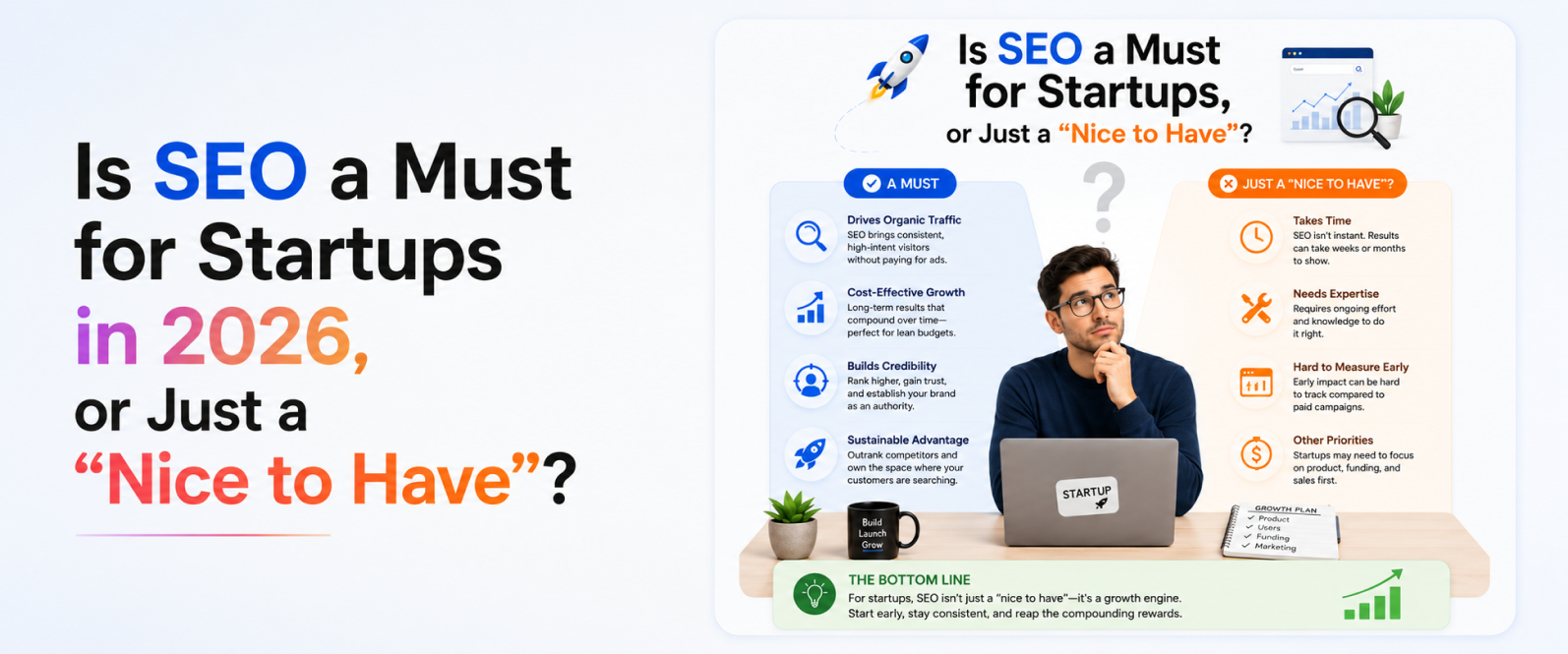
SEO is not optional for startups in 2026. It is one of the few growth channels that compounds over time, builds trust before a sale happens, and reduces a startup’s dependency on paid ads. Skipping it doesn’t save time — it just delays the point where organic traffic could have started working for the business.
That’s the direct answer. Here’s the full case, and exactly where a startup should start.
If you’re a startup founder, you already have a million things on your plate. Launching products, pitching investors, fixing bugs — and somewhere along the way, someone says “you should focus on SEO.” Your first thought is probably “maybe later, not right now.” But here’s the truth: later might be too late. Let’s clear the confusion once and for all — SEO isn’t an option, it’s a necessity. No jargon, just simple, real talk.
What Is SEO Really About?
Search Engine Optimization (SEO) isn’t just about ranking higher on Google. It’s about constant organic traffic. In practice, that breaks down into four outcomes for a startup:
Getting found — getting found by people already searching for what you offer
Building trust — building trust before people even land on your site
Getting traffic — getting free, consistent traffic over time
Reducing dependency — reducing your dependency on paid ads
If a startup is looking for visibility, trust, and leads, SEO is the channel built for exactly that.
Why Startups Need SEO
1. You're Competing With Bigger Budgets
Large companies are spending lakhs on ads every month. A startup may not be able to match that — but with SEO, you can get visibility without paying per click. It takes time, but once your ranking sticks, you don’t pay to stay there.
2. People Are Already Searching for What You Offer
What you see in the home scroll depends on:
If a startup built a product for freelancers to send invoices, people are already Googling things like “best invoicing app for freelancers” or “free invoice tool India.” A startup’s site should show up there — SEO helps you meet demand, not chase it.• How recent the post is
• How engaging it is (likes, saves, sends, comments)
Tip: saves and sends are the strongest signals here, aim to create content people want to keep
or pass along privately.
3. It Builds Trust
When someone sees a startup’s site ranking on Google, even without clicking it yet, it sends a signal. Organic results feel earned. That can mean the difference between a bounce and a conversion.
4. It Makes Your Other Channels Smarter
Good SEO teaches a startup what its audience is looking for, which keywords work best, and what content brings clicks. That research can be reused for social media posts, paid ad campaigns, and website copy. SEO gives you insights, not just traffic.
5. It Cuts Down Customer Acquisition Costs
Say a startup’s ad cost is AED 20 per click, with a 2% conversion rate. That works out to roughly AED 1,000 for a single paying customer — since 20 clicks at AED 20 each cost AED 400, and only one in fifty converts. With strong SEO, once a keyword or piece of content ranks, that traffic becomes essentially free, and customer acquisition cost drops significantly. More margin, no spend, long-term gains.
Do Startups Need SEO From Day One?
You don’t need to go all-in immediately, but you should start early. Here’s the order that actually works.
Step 1: Fix the Basics (Technical SEO)
Make sure your website:
Loads fast
Works well on mobile
Has proper meta tags, alt texts, and internal links
Doesn’t have broken links
Small things, big difference — and this is the layer most startups skip, then pay for later.
Step 2: Write About What You Solve
Start creating helpful blog posts that answer your users’ actual questions. For example, if you’re a SaaS for retailers, write pieces like “how to manage stock without Excel” or “best billing software for small stores.” This brings in early traffic — and the right kind, because it’s matched to real search intent rather than generic keywords.
Step 3: Set Up Google Search Console and Analytics
Track how people find your site, what they search, and what pages perform. This is what lets a startup improve based on data instead of guessing.
Step 4: Focus on One Core Page First
Don’t spread too thin. Build one solid page — a guide, resource, or landing page — rather than a major pet project. Promote it, link to it, and build smaller posts pointing back to it. This is your SEO cornerstone.
If You Ignore SEO...
You’ll probably depend on paid ads, which are expensive, word-of-mouth, which is slow, and social media, which is unpredictable. And later down the road, you might be saying “we should’ve started SEO sooner” — because SEO isn’t instant, it grows over months, not days.
Final Thought: SEO Is a Growth Tool, Not a Trend
SEO isn’t just gaining backlinks. It’s about understanding what your users want, and being there before they even start searching. If a startup builds its foundation now, SEO becomes a self-sustaining development or support system — not extra work for the team.
FAQ Section
How long does it take to see results from SEO?
Typically, SEO takes three to six months to show noticeable results, depending on your competition, niche, and how consistent your efforts are. Unlike ads, SEO compounds over time — the sooner you start, the sooner you benefit.
What's the difference between Technical SEO and On-Page SEO?
Technical SEO covers the backend — site speed, mobile-friendliness, broken links, and how search engines crawl your site. On-Page SEO covers content-level factors like keywords, meta tags, headings, and internal linking on each page.
Can I rank my website without backlinks?
You can rank for some lower-competition keywords without backlinks, especially with strong on-page SEO and relevant content. For competitive keywords, backlinks from credible sites remain one of the strongest ranking signals.
What are “cornerstone pages” and why do they matter?
A cornerstone page is the strongest, most comprehensive page on a specific topic on your site — built to rank first and act as a hub that smaller blog posts link back to. It concentrates authority instead of spreading it thin across many weak pages.
How do I know which keywords to target first?
Start with keywords that match what your actual customers are searching for, not just high-volume terms. Tools like Google Search Console, Google Keyword Planner, and AnswerThePublic can show real search intent; prioritize keywords with clear intent and manageable competition over vanity terms.
Ready to Build Your SEO Foundation?
SEO isn’t something to bolt on later — it’s infrastructure for growth. Innovahub helps startups across Dubai and beyond build SEO strategies that compound, so traffic and trust keep growing long after the campaign budget runs out.