 Home >> Google Ads Performance Max in 2026: The Complete Guide
Google Ads Performance Max in 2026: The Complete Guide
 24 – Jan,2026 – Social Media
Google Ads Performance Max in 2026: The Complete Guide
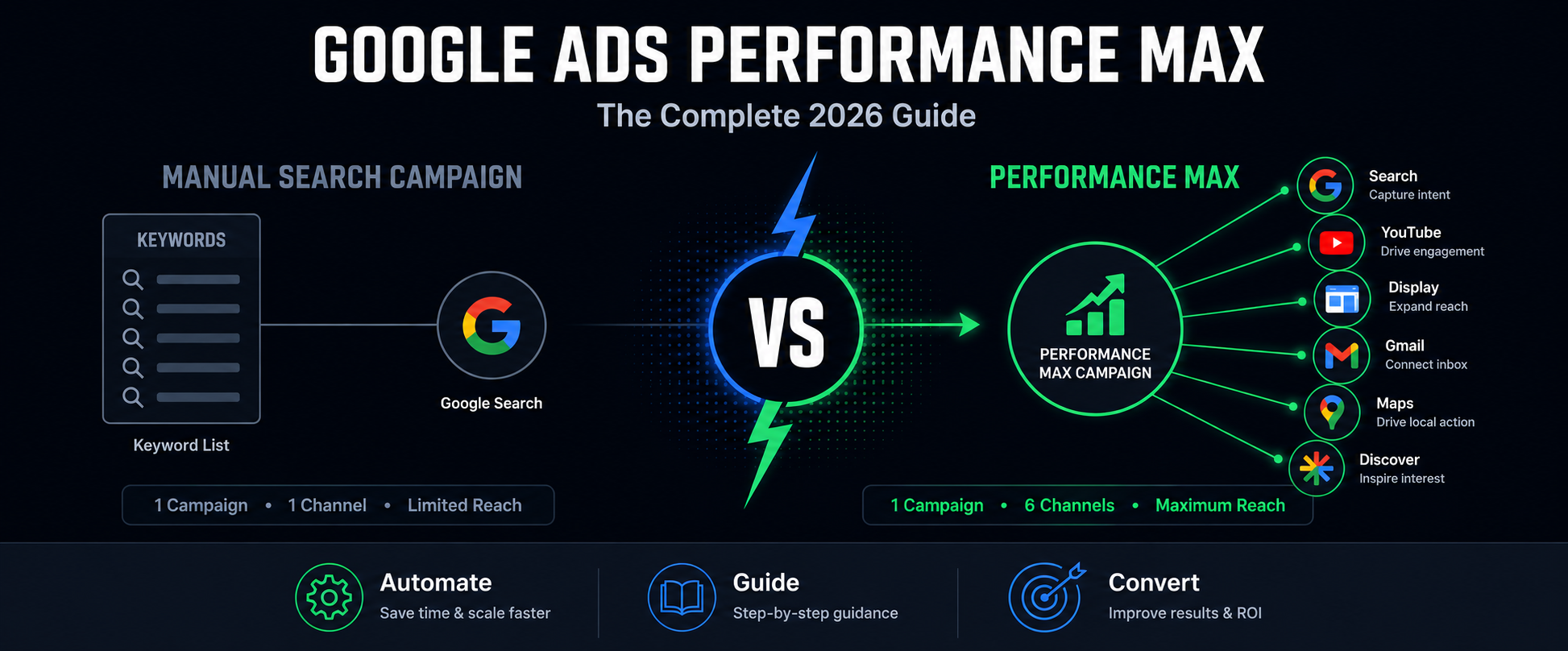
Google Ads Performance Max (PMax) is a single, AI-driven campaign type that automatically places your ads across Google’s entire inventory, Search, Display, YouTube, Gmail, Maps, and Discover, from one campaign structure, using machine learning to allocate budget toward the placements most likely to convert. PMax and traditional Search campaigns aren’t competitors. Search campaigns give you precise, keyword-level control; PMax gives you reach and automation across channels a manual setup could never manage by hand.
In 2026, most growth-focused advertisers are already running PMax, and adoption keeps climbing. But here’s the catch: businesses that hand PMax the keys and walk away are the ones burning the budget, while businesses that feed it the right signals are the ones seeing genuine growth from it.
That’s the short version. Here’s the full picture, including what it actually looks like when a PMax campaign is built the right way.
Set It and Forget It" Is Costing You More Than You Think
If you’ve launched a Performance Max campaign before, you’ve probably heard the pitch: turn it on, let Google’s AI handle the rest. That’s not a strategy, and treating PMax that way is exactly why so many advertisers see inconsistent results from it.
Why? Because PMax’s algorithm is only as good as the signals it’s given. Left with weak landing pages, generic creative assets, and no guardrails, it will still spend your budget, just not efficiently. Given strong signals, it becomes one of the most powerful automation tools in Google Ads.
Wider reach, one campaign reaching Search, YouTube, Display, Gmail, Maps, and Discover simultaneously Smarter allocation, Google’s AI shifting budget in real time toward whatever’s converting best Less manual management, no need to build and monitor six separate campaign types by hand
If a business is looking for automated reach without losing strategic control entirely, Performance Max is the tool built for exactly that, provided it’s set up correctly.
1. Most Advertisers Are Using It Wrong, Which Is Your Opening
Max performance has climbed sharply among advertisers over the past two years, and it’s now the default campaign type for most growth-focused accounts. But adoption isn’t the same as mastery, most advertisers are still running PMax as a black box, which means a business willing to actually guide the algorithm has real room to outperform competitors spending far more.
What Is Google Ads Performance Max?
Performance Max is a goal-based Google Ads campaign type that uses machine learning to automatically generate and place ad combinations, text, images, video, and product feeds, across all of Google’s advertising channels from a single campaign, rather than requiring separate campaigns for Search, Display, YouTube, and Shopping.
Unlike traditional Search campaigns, which give advertisers direct control over specific keywords and match types, PMax works from broader inputs, asset groups, search themes, and audience signals, and lets Google’s AI decide where and to whom your ads are shown, optimizing toward whatever conversion goal you define.
How Does Performance Max Actually Work?
Performance Max works by combining Smart Bidding with a shared pool of creative assets that Google’s AI assembles differently for each placement. In practice, that means a few things have to be true about a campaign at once.
Asset groups are built with real variety. Multiple headlines, descriptions, images, and videos give the AI more combinations to test, rather than one generic ad forced across every channel.
Search themes guide, but don’t replace, targeting. Advertisers can specify keyword themes per asset group to give PMax directional input for Search inventory, though with less precision than manual keyword bidding.
Account-level negative keywords are essential. PMax doesn’t support campaign-level negative lists through the standard interface, so account-level negatives are the main lever for blocking wasteful queries and protecting branded terms.
Landing pages are strong and specific. PMax needs signal-rich environments to perform well, a weak or generic landing page undermines the entire campaign, no matter how good the creative assets are.
Conversion tracking is accurate from day one. Since Smart Bidding is the default operating mode, poor conversion data means the algorithm is optimizing toward the wrong outcome from the start.
The practical implication: a PMax campaign launched with a thin asset group, no negative keyword list, and a generic landing page will still spend your full budget, it just won’t spend it well. Performance Max done properly is a system you guide, not a button you press.
Why Meta Ads and Search Campaigns Matter Too
Performance Max alone won’t cover the full picture either. That’s why two more pieces matter:
Search campaigns still give the most precise, keyword-level control for high-intent, branded, or competitor terms PMax may not prioritize correctly Meta Ads reach people before they’re actively searching, building the awareness that later shows up as PMax conversions Performance Max fills the gap between the two, capturing cross-channel demand a manual setup could never manage at the same scale
Think of it this way:
Search campaigns win the high-intent, precise moments Meta Ads build awareness before someone starts searching Performance Max captures demand across Google’s entire ecosystem at scale
Put all three together, and paid media stops being a single-channel bet and becomes a connected system your competitors likely haven’t built yet.
This is proof that Meta Ads lead generation isn’t about spending more, it’s about feeding the algorithm the right signals.
So, What's the Big Takeaway?
The biggest lesson here: automation isn’t a strategy, it’s a tool that still needs direction. A PMax campaign left on autopilot will spend your budget with or without good results, the difference between the two comes down entirely to the quality of the assets, landing pages, and conversion signals you feed it.
How Your Business Can Generate Revenue From Performance Max
Performance Max is no longer just a “set and forget” automation feature, it’s a cross-channel growth engine when it’s guided correctly. With the right structure, a business can:
Reach audiences across Search, YouTube, Display, Gmail, Maps, and Discover from a single, more efficient campaign Improve ROAS over time by feeding the algorithm accurate conversion data and strong creative variety Reduce wasted spend by protecting branded terms with account-level negative keywords
If your business’s Performance Max campaign is spending steadily but not converting, that’s not a PMax problem, it’s a signal problem. INNOVAHUB builds Performance Max campaigns around real conversion data and creative strategy, not default settings. Let’s make sure your ad budget is working as hard as the algorithm is.
FAQ Section
What is Google Ads Performance Max?
It’s a goal-based Google Ads campaign type that uses machine learning to automatically place ad combinations across Search, Display, YouTube, Gmail, Maps, and Discover from a single campaign structure.
How is Performance Max different from a Search campaign?
Search campaigns give advertisers direct keyword-level control. Performance Max works from broader signals, asset groups, search themes, and audience data, and lets Google’s AI decide where and how ads are shown.
Should I replace all my Search campaigns with Performance Max?
? No. Running Performance Max alongside traditional Search campaigns in a complementary structure typically outperforms replacing Search entirely, since Search still offers more precision for high-intent and branded terms.
Can I use negative keywords in Performance Max?
? Performance Max doesn’t support campaign-level negative keyword lists through the standard interface. Account-level negative keywords are the primary way to block wasteful queries and protect branded search terms.
Why is my Performance Max campaign spending budget without converting well?
This is usually a signal problem, not a platform problem, thin asset groups, weak landing pages, or inaccurate conversion tracking give the algorithm poor information to optimize against.
Do I need a large budget for Performance Max to work?
Like other Smart Bidding campaigns, PMax needs enough conversion volume to learn effectively. Very low-volume accounts may see less stable performance until the campaign accumulates sufficient data.
How can Performance Max, Search campaigns, and Meta Ads together help generate revenue?
Together they cover the full funnel: Meta Ads build early awareness, Search campaigns capture high-intent searchers precisely, and Performance Max captures cross-channel demand at scale, turning ad spend into a connected system instead of three separate bets.
Ready to Build a Strategy That Actually Works?
A Performance Max campaign is only as strong as the signals behind it. Innovahub helps Dubai brands turn automated ad spend into a focused, measurable growth engine built for how Google Ads actually works in 2026.